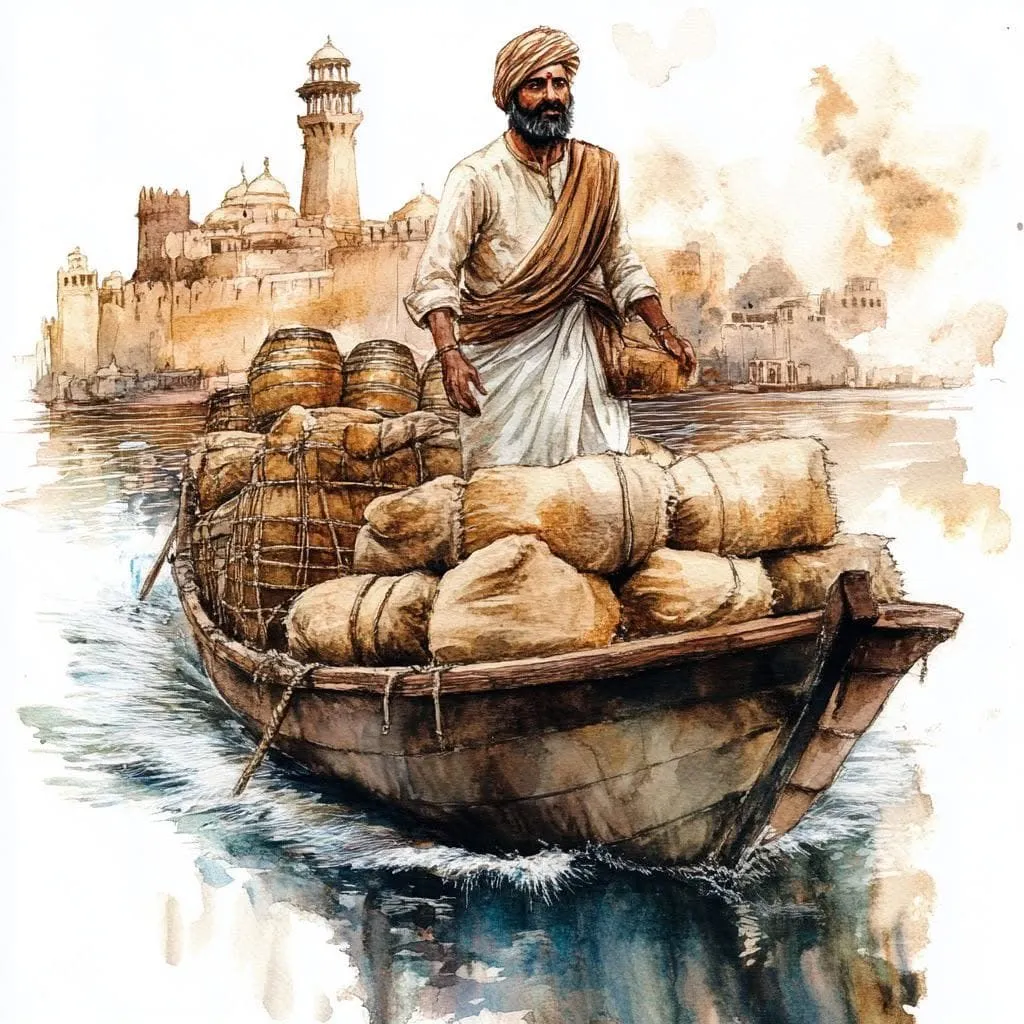
On the banks of the Karnaphuli river (known locally as Kãichya) was a city named Basanti Nagar. There lived Kamal Saodagar, the merchant. He had a grand two-story building surrounded by a garden filled with countless varieties of flowers and fruits. The sheer grandeur of the main gate of the merchant’s house was so dazzling that it left all the townspeople in awe. The merchant’s wife, Surongini, was unparalleled in beauty and virtue. Their home was brightened by their two sons—Chanmoni and Surjomoni. There was no lack of motherly affection for her golden, doll-like sons.
Surongona also had a handmaiden named Moifula. Moifula had no children of her own, so she loved Chanmoni and Surjomoni as if they were her own sons. The merchant’s moon and sun grew up surrounded by the love and affection of their mother and their “aunt,” Moifula. But perhaps it is the nature of happiness that it does not last long. And so, one day, the merchant’s wife fell ill and passed away. The two children cried inconsolably in the house, and seeing their tears, the father’s eyes also filled with tears. Seeing the state of the household, the handmaiden Moifula, the boys’ aunt, kept her own sorrow in her heart and took upon herself the entire burden of the household. And why wouldn’t she? After all, before she died, Surongona had held her hand and entrusted the responsibility of the boys to her!
When they cried of hunger, she fed them; when thirsty, she gave them water.
She stayed with the two boys day and night.
The household was managed one way or another. But what would happen to the merchant’s trade and business? His wife had been the embodiment of Lakshmi, the goddess of fortune, and after her death, nothing went as it had before. It is said, “When fate breaks, a crocodile will eat you on dry land.” The merchant now found himself in that very situation. He suffered losses in his business, and his ships were swept away into the dark waters of the sea. In his happy days, there had been many people by his side, but in this time of distress, the merchant found no one. All the servants, maids, and sailors in his house packed their belongings and took jobs elsewhere. Only Moifula remained in the house, and in the office, Gobordhon the clerk. The merchant had treated him like his own brother.
One day, the clerk came and proposed that the merchant should remarry. Only if he married again and put his household in order would good days return to his business.
The golden household has been ruined.
A fortune in merchandise has been swept away by the sea.
We all say you should marry again.
Although he initially refused, the merchant agreed for the sake of his home. The clerk spread the news of the marriage far and wide. Word came that in the village of Dharmapur, in the house of a poor merchant named Dharmamoni, there was a beautiful daughter named Sonai.
The shehnai played, and the marriage took place, but the merchant no longer had his former zest for life. He did not connect with his new wife. With no meeting of minds, the discord in the house only grew, and in step with it, his business losses mounted.
Kamal Saodagar fell into great sorrow.
All his money and wealth were destroyed.
The goddess Lakshmi left, seeing the injustice.
Ten of his sloops, laden with paddy,
Sank in a monsoon storm.
Meanwhile, unbeknownst to the merchant, a romantic relationship developed between Sonai and Gobordhon. Finding no affection from her husband at home, the new wife Sonai set her sights on Gobordhon. Gobordhon was no less of a charmer himself in his mannerisms and speech. When Sonai blamed Gobordhon for her unhappiness, he could say nothing. Day by day, through letters and meetings, their love blossomed like a new spring. The old husband at home now felt like poison to Sonai. She wanted freedom from the merchant. So she hatched a plan to send the merchant to a distant land so she could live happily with Gobordhon. Kamal Saodagar knew nothing of this; hearing talk of trade from his wife’s lips, he understood that domestic profits were not enough for her; she wanted foreign earnings. After some thought, he handed over all the responsibilities of the house to Gobordhon and, as he was leaving, tearfully entrusted his two sons to the handmaiden Moifula.
The merchant went off to earn from trade
And Gobordhon drowned in the ocean of Sonai.
And what of Chanmoni and Surjomoni, the light of their mother’s lap, the apples of their father’s eyes? The torment of their stepmother made their lives a misery of constant tears. They would only hide behind Moifula. Sonai gave them only burnt rice and stale eggplant to eat. Due to the lack of food and care, the two boys’ faces grew thin. This is how the days passed.
One night, Sonai was asleep in the room where kohl was kept. In the middle of the night, she had a dream: she saw her two stepsons had become kings, and a hangman’s noose was around Gobordhon’s neck. Surongona was untying the noose, and Sonai was drifting away on the sea, just as all the merchant’s boats had drifted away. Seeing such a dream, Sonai trembled with fear. She immediately plotted to kill the two boys, no matter what. But the handmaiden Moifula protected the two boys as if they were her own children. So, what could be done? First, Moifula had to be removed from the path. She then went to Moifula and feigned friendship.
Placing a hand on Moifula’s cheek,
Sonai said lovingly,
“I’ll arrange another marriage for you.”
A suitor to your liking,
I will find for you.
You’ll stop being a handmaiden and become a king’s queen.
Hearing Sonai’s words, Moifula’s eyes widened. She understood the wicked plan perfectly. She said nothing and walked away with a smile. Rebuffed, Sonai then hatched another plan. She brought a wicked man from the village and set him on Moifula. That chieftain, named Manik, harassed Moifula so much day and night that she could no longer stay in the village. Although her heart ached for Chanmoni and Surjomoni, she also needed to save herself. She then went into hiding a short distance away, waiting for a chance to catch Sonai in her evil deeds. Sonai did not delay in showing her true colors either. That very night, she told Manik the chieftain to take the two children somewhere far away and kill them. At night, as Manik took the two beautiful, sleeping merchant’s sons into the jungle and raised his sword to kill them, the handmaiden Moifula suddenly rushed out from nowhere and offered her own chest. Seeing Moifula in such a state, Manik’s heart melted. He then told her everything. How Sonai had sought him out to kill the two boys, how she had also set him upon Moifula—he left nothing out. Hearing everything, Moifula then came up with a plan.
Rescuing Chanmoni and Surjomoni from Manik the chieftain, Moifula set out on an unknown path. The three of them had no idea where they were going. They just kept walking. After walking for a long time, they came upon a jungle. Exhausted, the two boys lay down under a Garjan tree.
Headaches rose in their heads, fever rose in their bodies,
Lying under the tree, they trembled and shivered.
Who would give them medicine, and where was food and water?
All they had to wear were two pieces of torn cloth.
Seeing the condition of the two boys, Moifula’s heart broke. How would she bring them food, and how would their sickness and fever be cured? If she left them alone to search for food or medicine, could she trust that they would be safe? There was no shortage of tigers and bears around. While thinking these things, Moifula heard someone cutting wood in the distance. Rushing there, Moifula clasped her hands and said, “Brother woodcutter, my two precious souls are lying under the Garjan tree. They have a high fever. Please, kindly give them shelter.” The woodcutter was young, and his heart was soft. He replied in a single word—
“Bring both the treasures with you and come to my home.”
But by then, the worst had already happened. Returning to the Garjan tree with the woodcutter, Moifula’s eyes widened in shock. Oh no, where was Chanmoni, where was Surjomoni? Where had they gone, leaving their aunt’s heart empty? Moifula cried inconsolably, fainting from time to time. The young woodcutter then took her to his own home.
Meanwhile, Sonai Bibi, hearing no news from Manik the chieftain, sent Gobordhon. Gobordhon went and saw Manik’s hands and feet were tied, with a two-and-a-half-maund stone placed on his chest. After rescuing Manik, he began to spin another tale, not letting a single word of the truth slip from his mouth. How could he? He was trembling with fear of Sonai Bibi! But Sonai was not fooled by the false story. She understood the real situation. Manik the chieftain also seized the opportunity and fled from there; he was never found again. Sonai then sent Gobordhon in search of the handmaiden Moifula.
Meanwhile, Moifula was living at the woodcutter’s house, her days passing in grief for the two boys. She would cry out in her sleep—Oh Chanmoni, my dear Surjomoni! What had actually happened was this: when Moifula went to find the woodcutter, the two boys woke up. Restless with thirst, the two brothers wandered through the jungle. They found a mountain spring, and after drinking the magical water from that spring, both of their fevers disappeared. Then began the hunger for rice. It was not just any hunger; it felt like a fire was burning in their stomachs. Disoriented with hunger, they both lost their way and could no longer find the Garjan tree. For several days, they wandered in the jungle. They ate whatever fruits they could find, and the two brothers would grieve together and sleep under this tree or that tree at night. The days were passing like this, but one morning, a strange event occurred. Out of nowhere, a huge white elephant came crashing through and, swaying its trunk, lifted Chanmoni onto its back. On the elephant’s back was a large throne, and placing the merchant’s son there, it vanished deeper into the jungle in an instant. Waking up, Surjomoni could not find his brother anywhere. Until now, they had been two sorrowful brothers; now he was all alone!
In the southern country, there was a mountainous region. When the king of that region died, he had no heir. The subjects then threw the kingdom into turmoil.
The king has died, with no son or daughter.
Many claimants have appeared for the throne.
The kingdom is ruined by the king’s faults, the subjects suffer.
Who will be the king of this kingdom? Let’s think of a way.
Gold and silver are corrupted by copper and brass.
A king is ruined by injustice, honey is ruined by water.
After much deliberation, the vizier announced, “There is a white elephant that lives in the royal stable. It is no ordinary elephant; it knows the past and the future. That elephant will decide who will be the king of this kingdom.” The white elephant wandered through many lands and finally appeared before Chanmoni. Because from birth, he had a royal mark (rajtilak) drawn on his forehead. Although no one else could see that mark, it did not escape the eyes of the royal white elephant. The writing on his forehead came true; Chanmoni became the king. But alas, where would he find his brother? Even after sending out soldiers and messengers, Surjomoni could not be found. The king’s nights became sleepless with worry. Meanwhile, weeping for his brother, Surjomoni’s tears caused the water of the mountain stream to rise. A group of bamboo merchants floated by on that water. Seeing Surjomoni, they took him onto their raft.
That group of bamboo sellers reached the royal riverbank with their boat. The owner of this ghat was none other than the king of that strange country, his own brother, though Surjomoni did not know this. Moored at that ghat were fourteen of a merchant’s boats. On the night Surjomoni arrived at the ghat with the merchants, the merchant had a dream—the god of the sea demanded a human sacrifice! After waking up, the merchant sat with a bag of a thousand takas in his hand.
“For the god’s offering, one person is needed.
Where can I buy a person for a thousand takas?”
Hearing this, the bamboo merchant quickly sold Surjomoni to the merchant. And taking the bag of a thousand takas, he fled with his group. They didn’t even look back at Surjomoni. The merchant’s men dressed him, fed him, and prepared him. They tied his hands and feet tightly and threw the poor boy into the middle of the sea.
One wave lifted the precious one as high as the sky,
Another wave threw him onto a desolate sandbar.
Near the sandbar was the house of a fisherwoman.
The next morning, the woman came to that sandy shore.
Seeing Surjomoni, the fisherwoman felt great pity. She quickly took him to her home. She nursed him back to health. And so, one of the merchant’s sons became a king, and the other ended up in the house of a fish seller. Neither of the two brothers was happy; they only shed tears thinking of each other.
If there is no happiness in the heart, what good is a kingdom?
Does sweet rice pudding taste good to one with a stomach ache?
When his two sons were in such dire straits, their father, Kamal Saodagar, after finishing his twelve-year trading voyage, was mooring his boat at the royal riverbank. It took several days to drop anchor at the ghat. During this time, he met the local people and saw a boy with a golden complexion living in the fisherwoman’s house. Seeing that boy, the merchant remembered his own son. Such is the irony of fate that a father cannot recognize his own son.
At such a time, the ghat-keeper came and informed him that the merchant’s boat could not leave. Not even for a thousand takas. The king himself would come to meet the merchant. The merchant was overcome with fear; what had he done to become the king’s eyesore? What was his fault? Just then, he saw a golden doll-like figure, his royal crown glittering, running towards him and calling him “father.”
The new king fell at the merchant’s feet.
Calling ‘Father, father,’ he soothed his soul.
Seeing Chanmoni, the merchant’s eyes were opened. Then the unknown boy from the fisherwoman’s house must be his other son, Surjomoni! The brothers were reunited. The father recognized his sons. After twelve years, the two brothers, meeting their father, told him of all their sorrows and asked what had happened to their aunt Moifula, what had happened to their home. The father and sons quickly went home and saw Sonai sitting there as a queen. There was no sign of Moifula. Everyone said that the handmaiden had died long ago! Hearing this, the merchant grabbed Sonai by her hair, took her to the middle of the river, and threw her into the dark waters. Gobordhon and Manik had already fled.
After that, Chanmoni ruled happily with his brother. The merchant, having finished his trade, also rested comfortably in his son’s kingdom. The subjects were also very happy to have a new king. The days were passing well like this. One day, suddenly, a madwoman appeared in the royal court. In the words of her song, she spoke of the tyranny of a stepmother, of two golden doll-like brothers. The two kings, seeing her, ran to her and said, “Aunt Moifula!” But the madwoman understood nothing. She only shed tears from her two eyes and, lying in a corner of the palace, thought of her unfortunate life and sang her baromasi—her twelve-month songs of sorrow.