It was Allah’s divine will to send a prophet named Manik to the world—an avatar who would spread His word. In the age of Kali Yuga, this chosen one would come to Earth and enlighten people about Hajj, Ghazi, Muhammad, Rahim, Karim, Rasul, Paygamber, Izzat, and Mother.
Badr stepped forward and said he was ready to take on this responsibility.
Allah praised His beloved servant Badr for his devotion but also issued a warning: he must never fall under the sway of any woman, for that would lead him astray.
After learning all of Allah’s divine instructions, Badr began preparing for his mission. But before he left, he made a humble request:
“O Lord, may I descend to Earth in the guise of a wandering mystic?”
Allah accepted his request and provided him with the attire of a fakir—a cloak (alkhalla), pajama, waistband, and a staff—to begin his sacred journey.
Badr’s loyal companion on this sacred mission was a majestic horse named Duldul. In his hand, he carried a special bamboo staff (ছড়া বাঁশ), a symbol of his divine purpose. Badr himself was strikingly handsome—adorned with a garland around his neck, a cap on his head, and garments glittering with jewels and pearls. With unwavering faith in Allah, he set forth on his journey.
Chanting the holy name of Allah, Badr made his way toward Delhi. His first stop was in the city of Lahore. Disguised as a wandering fakir, he moved humbly through the streets, accepting alms.
As he journeyed, the phrase “Dam Dam Madar” echoed from his lips. It was said that with this chant, Badr could travel great distances in no time.
People—both men and women—would approach him with devotion, offering a golden plate with four coins, saying:
“O holy one, please accept our humble offering.”
But Badr would gently decline, saying:
“Unless I am truly your Murshid (spiritual guide), I cannot accept your gift.”
Confused, the people would reply:
“We’ve never truly found a real Murshid in our lives.”
To which Badr would say:
“Then repeat after me, ‘Ed Allah! Ed Allah!’ three times. Only then shall I accept your offering. Otherwise, to accept it would be a sin in the court of Allah.”
Then and there, the people of Lahore accepted Badr as their Murshid. Word spread like wildfire. Crowds gathered, and golden offering plates piled high at his feet. With tearful eyes and trembling voices, the people said:
“We enshrine you in our hearts for eternity.”
The women wept openly, overcome with emotion, clinging to the hem of his robe. Many begged to accompany him on his journey. But Badr, calm and resolute, gently consoled them:
“This path I walk is for the sake of Allah’s message. Your prayers will travel with me.”
Leaving their love behind, Badr turned once more toward his mission.
From Shantipur, he journeyed on to Shahbazar. There, he spoke with Golam Ali Sahib, expressing his intent:
“I shall go to Chattogram, to spread the divine message of Allah.”
Crossing rivers and streams, enduring the elements, Badr eventually reached Saptagram, where the holy Ganga Devi flows in all her majesty.
By the ghat of Tribeni, a group of ancient sages and rishis sat in deep penance. They had meditated for so long, in complete stillness, that the earth itself had grown over them—grasses, vines, moss covering their bodies. Yet despite their efforts, their hearts were restless, and for this reason, they could not witness the sacred vision of Ganga Devi.
Upon seeing Badr, the sages scoffed, mocking him as a “cursed beggar”. Their voices were heavy with pride and sarcasm:
“This fool thinks he can summon Ganga Devi? We’ve sat here twelve years, in silence, rooted to the earth in penance, and still she hasn’t appeared to us. And he claims she’ll come just by calling her?”
Their laughter echoed through the sacred grove.
But Badr, calm yet stern, responded:
“If your hearts were truly still, your eyes would already have seen. But since you doubt—witness now the grace of Allah.”
With those words, he spread out his tiger skin mat, sat cross-legged, and entered deep concentration. His eyes fixed upon the river, he softly uttered:
“Ganga, appear before me. Your elder brother calls.”
At once, the waters stirred.
The wind changed.
And then—Ganga Devi herself began to rise from the depths, radiant in divine light.
The sages, stunned, could only watch as their pride dissolved. As Ganga emerged, their bodies trembled with realization. In awe and surrender, their arms stretched wide—four hands each, the form of their souls transformed—and they ascended to Brahmalok, the realm of creation.
Badr, unmoved, spoke again:
“I wish to see the lotus-feet of Ganga Devi.”
But Ganga, divine and powerful, replied with a challenge:
“I do not reveal myself to Yavanas (non-Hindus). But if you, O Badr, can withstand the force of seven waves of my fury, only then will I grant you my darshan.”
Without hesitation, Badr accepted.
As the waves of Ganga Devi began to swell—colossal, roaring like lions—Badr quickly realized the magnitude of what he was up against. The mighty current raced toward him, crashing like a wall of water determined to test his faith.
In that moment of looming peril, Badr did not flee.
Instead, he closed his eyes and whispered with unwavering devotion:
“Ya Allah… save me now. Only You can.”
And Allah, in His infinite mercy, heard His beloved servant’s plea. With a single divine command, He summoned the Wind (Pawan) and ordered:
“Go at once—aid Badr. Help him contain the river.”
Instantly, the wind raced across the heavens to Badr’s side. Badr, understanding the divine signal, opened his satchel, holding its mouth wide open toward the oncoming waves.
The towering waters rose, furious and immense—seven waves in all, each greater than the last.
But Badr stood firm, bathed in Allah’s light, as the final wave surged forward.
And just as it was about to crash down upon him—Ganga Devi herself was drawn into the satchel, her divine form gently pulled in by the breath of wind.
With swiftness and reverence, Badr tied the satchel shut, sealing the powerful goddess within. The mighty Bhagirathi river was now under his command.
To celebrate this miracle, Badr sat at the riverbank and began to sow jute seeds (pāt).
By the grace of Allah, the earth responded instantly. Shoots burst forth from the soil. In a single day, green leaves unfurled, and by the seventh day, full-grown stalks with roots, flowers, and even fruit appeared—an entire jute harvest, as if from paradise itself.
Overjoyed, Badr carefully harvested the pāt shak (jute greens), cooked it with pure devotion, and offered it to Allah in humble gratitude.
Meanwhile, Ganga Devi, exhausted from her struggle, finally surrendered.
“I accept it—you are my elder brother from a past birth. Please, release me now.”
Badr, with calm authority, replied:
“I can release you, but only if you promise to calm down.”
The goddess nodded in agreement. At that, Badr untied the satchel.
The moment the satchel opened, Ganga surged forth, crashing with a divine roar and flooding the Triveni Sangam. From that day on, the river at that very spot curved like a hunchback, creating the distinct, bent formation we still see today.
Now with peace restored, Badr made one final request.
“Sister Ganga, bring me stones from the Setubandh (Adam’s Bridge), for I wish to build a mosque here at Triveni.”
Moved by his devotion, Ganga Devi summoned her mystical powers. Stones from the distant Setubandh rose to the water’s surface, floating effortlessly as if blessed by the divine.
She guided them across the river, floating upon her current, and gently laid them at Badr’s feet.
Overjoyed, Badr raised his voice toward the heavens and called upon the cosmic architect, none other than Vishwakarma himself.
He welcomed the divine builder with offerings of betel leaves and flowers, and humbly requested:
“Build me a mosque here—within seven days and seven nights.”
Vishwakarma agreed, but with a condition.
“I will build your mosque, but the night must not end. The moment dawn breaks, I shall leave, even if the mosque is unfinished.”
Badr understood the gravity of this request. That very night, he called upon Night herself and requested her:
“For the next seven days, stretch yourself—remain dark, so that no light of dawn breaks my prayer.”
The Night bowed to Badr’s will, and so it was done.
Wrapped in this eternal twilight, Vishwakarma began his work.
Two days passed in divine twilight—everything going smoothly, the mosque rising stone by stone in the eternal night. But then, a worry stirred in the heavens.
Allah, gazing down from His celestial seat, began to feel a divine unease.
“What if this mosque… turns out more beautiful than even the ones in Mecca, Medina, or Paradise itself?”
Such magnificence could not go unchecked.
So, He summoned Ali, the Lion of God, and whispered His command:
“Take the form of a white crow, and swiftly descend to the Earth. Let your cry usher in the dawn.”
Ali obeyed without hesitation.
Moments later, a white crow perched silently on a magnolia branch near the construction site. Then, in a burst of sound, it let out a haunting:
“Kaa… Kaa…”
That cry tore through the darkness like thunder.
Suddenly, the spell of night broke. The moon disappeared in the brightening sky. Morning had arrived.
And with it, Vishwakarma vanished, his divine axe falling from his hand, leaving the mosque half-finished, frozen in time.
Seeing the structure incomplete, Badr remained calm, knowing every divine act has its reason.
He then called forth Doforga Gazi, his loyal ally.
“You will now remain here at Triveni. The people shall bring you offerings of flowers and sweet rice (shinni) in reverence.”
Before leaving, he planted a sacred symbol—a banner marked with the image of a snake couple’s egg, representing eternal life and divine guardianship.
Then, donning his wooden sandals, Badr crossed the river Ganga, the waters parting as if bowing to his presence.
His next destination?
Chattogram—but not before he paid a visit to the emperor of Delhi.
In the royal court, Badr appeared like a bright moon in the darkest of nights, radiating an aura of serenity despite his humble attire. However, the king was puzzled by his appearance and asked, “What do you seek here?”
Badr calmly responded,
“Sire, I have a request. But first, you must promise to fulfill it before I tell you.”
The king, enraged by the audacity of the request, retorted sharply, and the vizier fumed, “Who are you? How dare you speak to the king this way?”
Badr, unwavering, replied,
“King, I fear you not. Know this—your future son-in-law stands before you.”
The vizier immediately snapped, “Sire, imprison him for three days in the dungeon!”
At the king’s command, guards moved forward to apprehend Badr, and they began to strike him. But just as quickly as they touched him, he vanished from sight before the eyes of all in the court. Everyone was left in astonishment.
Meanwhile, Badr made his way into the forest. There, he sat, contemplating his next move. He decided that he would use his tigers to bring the king’s daughter to him.
And so, Badr called upon his tigers.
At Badr’s call, an innumerable number of tigers came rushing towards him. Leading them was the Tiger Chief, Hum (হুম), who gave Badr a royal salute. With mighty roars, the tigers arrived one after another—Ked, Med, Gobaga, Sobaga, Jatia, Matiya, Kala, Tarangini, Abalak, Samalak, Nakeshwari, Sona, Dhana, Uda, Buda, and in total, there were 12 lakh tigers. Each of these tigers had their own unique powers.
-
Some tigers’ roars could silence the heavens, the earth, and even the underworld.
-
There were those who could travel eighteen days’ journey in a single night.
-
Some could disappear into the muddy waters of the jungle, lying in wait to pounce on humans along the riverbanks.
-
Some tigers would flee in fear at the scent of humans, while others would instill terror in the hearts of forest dwellers.
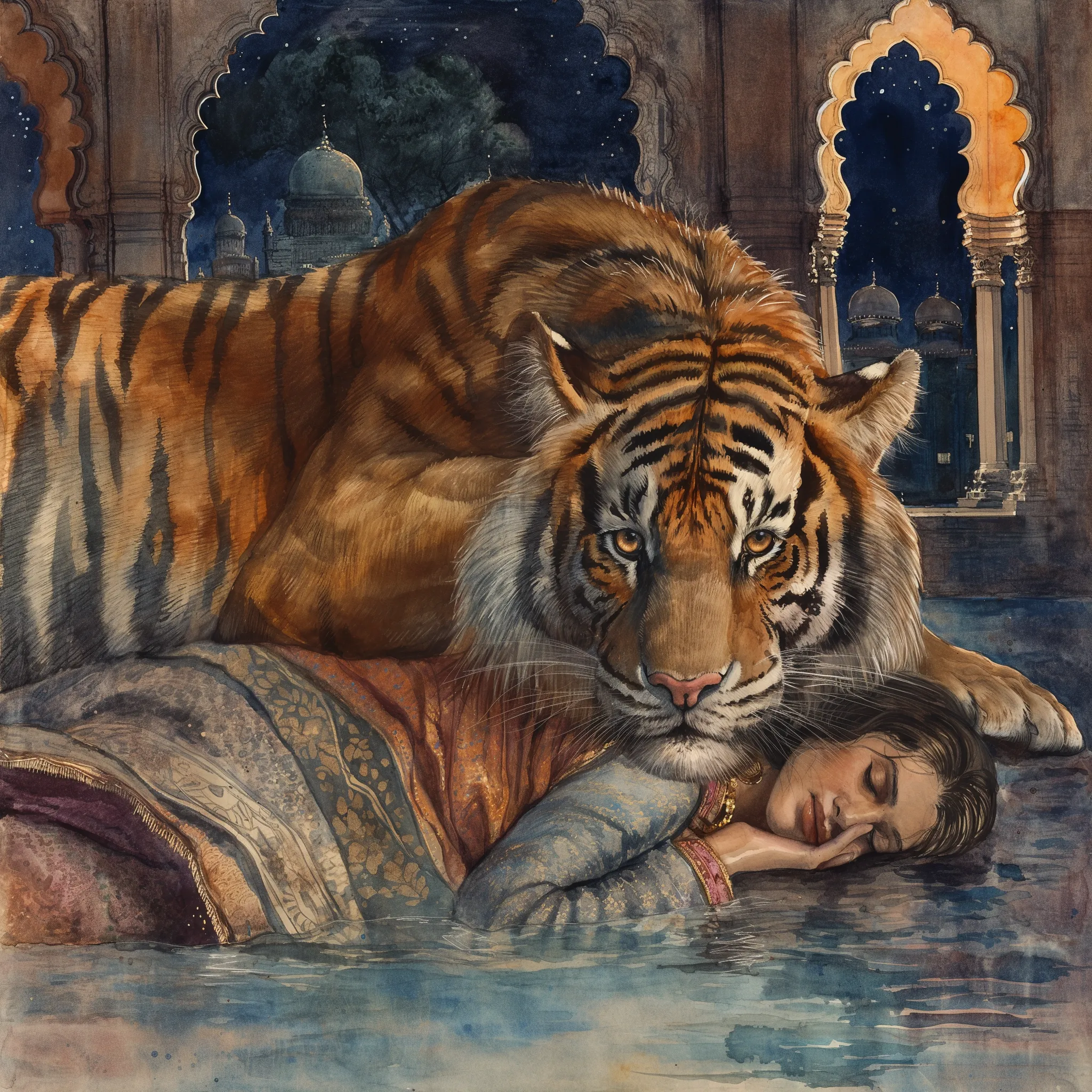
Badr, with a joyful heart, accepted the tigers’ salute and immediately ordered them to bring the princess from the king’s palace. As soon as the command was given, four tigers set off. The night was as dark as ink. Quietly, the tigers scaled the palace walls and descended into the palace garden. Princess Dudbibi was asleep in her chamber, bathed in the light of nearby lamps. Her bed was surrounded by a delicate mosquito net, and she lay deeply in slumber, as innocent and pure as a flower.
The four tigers quietly lifted the four corners of her bed. With a synchronized leap, they cleared the walls without waking the princess. They carried the bed as if it were light as air, crossing into the forest and placing it before Badr. When Badr gently lifted the mosquito net, it felt as though two moons had joined together. The princess’s unparalleled beauty mesmerized him. He softly called, “Wake up, wake up.”
When Dudbibi awoke, she was astonished.
“Who are you? Why have you brought me to this forest?”
Badr explained,
“Listen carefully. The king insulted me in his court. That is why I had the tigers bring you here. Now, marry me, and everything will be set right.”