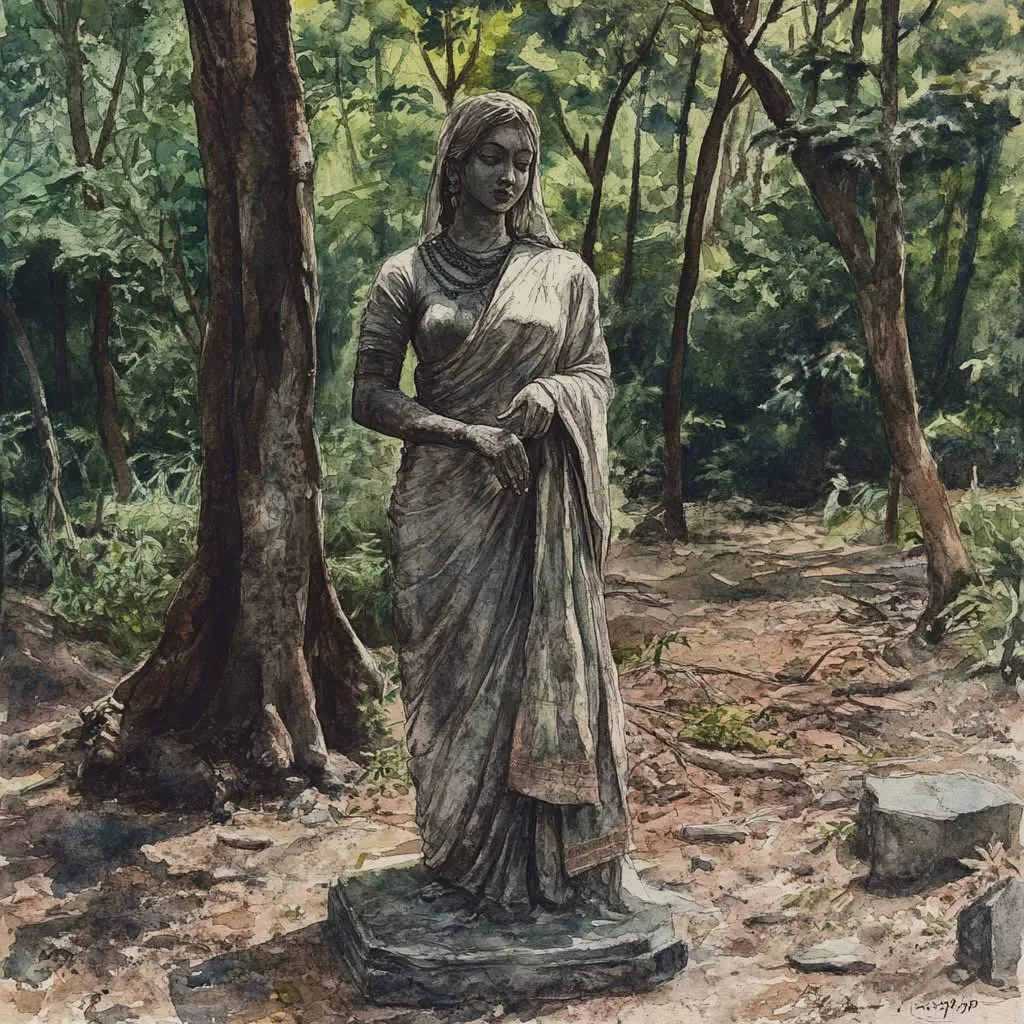
In the city of Teloinna, King Manohar and the enchanting Moyna Sundari were blessed with a divine daughter—Velua Sundari.
Her beauty? Like a celestial apsara from the heavens, her features bathed in the mystical glow of moonlight.
Her eyes? Like black bees nestled in lotus petals—deep, mysterious.
Her smile? A flash of lightning, and her teeth sparkled like scattered pearls.
By the time she crossed her twelfth spring, when she stayed alone in the temple chamber, her beauty shimmered like incense mist over a sacred lotus pond.
In Shamla Port, a distant land, another young soul was growing—Amir Sadagar, the son of Manik Sadagar and Sonai Sundari.
At fourteen, he was a youth whose beauty rivaled the full moon at midday.
One day, a thought stirred within him—he must journey to the city of Teloinna, driven by a thirst for the hunt.
He commanded his boatmen, “Prepare fourteen dinghies for my voyage.”
Each dinghy was prepared with great care—some filled with spices and rice, others adorned with trays of sweets, and one carrying the sacred verses of the Qur’an.
One dinghy was named Hansamala, another Kanchanmala, and alongside them marched rows of soldiers—symbols of strength and courage.
Amir’s fleet drifted toward Teloinna, carried by a current that whispered of destiny, flowing steadily toward the fate of two souls.
The fourteen-day journey seemed to vanish in just three. Teloinna City appeared—a land where nine lakh doves flutter through skies woven with legend. With a hunter’s heart, Amir released the tip of his arrow, and down fell a golden dove, as delicate as rose petals. But that golden dove was Velua Sundari’s most beloved. Struck by grief, Velua began to wail. Her cries reached the ears of her seven brothers, who came rushing to her side. Learning of the incident, they confronted Amir. Yet Amir felt no remorse. Instead, his boatman proudly declared the dove’s worth, offering to pay its price. Enraged by such arrogance, the seven brothers erupted in fury. They vowed to drown Amir in the sea. Thus began a fierce and thunderous battle between Amir Sadagar and Velua Sundari’s seven brothers.
With cannons, gunpowder, and weapons drawn, both sides lunged into battle.
Countless lives were lost—thousands upon thousands perished in the chaos.
After seven brutal days, Amir was defeated.
The seven brothers captured him and, after beating him severely, pinned him down beneath a heavy stone.
One day, Velua’s mother heard Amir’s cries. She went to him and, as they spoke, discovered his parentage—his mother, father, and the name of his city.
To her shock, he was none other than the son of her sister-in-law—the very boy she had once promised would marry her daughter.
Realizing this, she commanded her seven sons to release him.
Then she adorned him in a regal coat, a white dhoti, a jeweled turban, and elegant Chinese shoes.
At last, on an auspicious day, Amir and Velua were married.
Witnessing their beauty side by side felt like watching the moon and the sun come together in perfect harmony. With his new bride, Amir returned to his homeland—Shamla Port.
There, in the embrace of his weeping parents, he began a life of love and tenderness with Velua by his side.
But fate is ever-changing—And soon, Allah turned the wheel of fortune, bringing upon them days of sorrow once more.
Amir had an unmarried sister named Bibla Sundari.
She could not bear to witness the blissful married life of Amir and Velua.
Time and again, she taunted Amir—asking why he had abandoned trade and now idled at home with just his bride.
Worn down by her constant jibes, Amir finally told his mother and sister that he would set out for trade once more.
But the moment Velua heard of his departure, she broke into sorrowful wails—
her heart heavy with the fear of separation.
“Who will you leave me to, hidden away like a secret?
In this house—your mother, your sister—they are like fire itself.
They will burn me alive, not with flames,
But as though I were made of wood.”
Before departing, Amir pleaded with his mother and sister—asking them not to burden Velua Sundari with any chores. Yet, deep in his heart, he longed to taste a meal lovingly prepared by her hands. Velua, with devotion and care, cooked a variety of dishes and fed him with affection.
After the meal, Amir asked for some tobacco. But when he requested fire, Velua gently refused to bring it. Enraged by this, Amir struck her with the stem of his hookah. The pain overwhelmed Velua, and she fainted—
and without another word, Amir left her there, unconscious, and set sail for his trade journey.
As the boats began to move, the boatman, Gaural, warned him,
“You have wounded Velua’s heart—so you will lose your way.”
And indeed, after rowing through the night, they found themselves back at the very same dock from where they had departed.
Only then did Amir realize his mistake. He returned at once—to see Velua again, and seek her forgiveness.
As Amir departed, Velua’s heart was restless with worry. She made a vow to Allah—
that she would offer a thousand takas worth of sweets in His and the angels’ name,
and another thousand in the name of Ghazi Kalur.
Ghazi Kalur, who had been warned, was threatened with a dire consequence:
“If you do not bring Amir back to Velua, we will crack your skull open.”
In response, a traveler sent a bird, carrying a message to Amir.
Riding on the bird’s back, Amir journeyed back to Velua,
guided by the delicate wings of destiny, to meet her once more.
When Velua saw her husband, her joy knew no bounds.
The two of them spent the night lost in love and passion.
As dawn broke, the birds called three times,
and Amir, in haste, left the door ajar and departed.
Velua, deep in her slumber, remained unaware.
Upon waking, she found that her beloved husband was gone.
Around her, the people began to accuse her, calling her unchaste and dishonorable.
Overcome with grief, Velua cried out in sorrow:
**“Give me the Qur’an, give me the holy book,
I will touch the house of God.
Without my husband,
I know nothing of this world or the next.”**
But no one believed her words.
Velua, once the cherished daughter of her parents and seven brothers—
the girl who had slept on a golden bed, whose feet never touched the ground—
was now made a servant by Amir’s sister, Bibla.
She was ordered to clean the dung of thousands of cows,
grind a whole five seers of chili,
and fetch water from the Jamuna alone.
**“The saint went to trade, and left me as the sole one,
Now my mother-in-law and sister-in-law have become my tormentors.”**
Velua went down to the Jamuna to bathe, her water pitcher in hand.
But the weight of her long hair kept her from rising from the water.
In her desperation, she began to call out for help, her voice echoing across the river.
Hearing her cries, a few young boys arrived at the scene.
Velua pleaded with them, asking for their help to pull her ashore.
In return, she promised them various fruits and gifts.
The boys, with kindness in their hearts, used a tree branch to lift her from the water’s edge.
Now, let us hear the tale of Bhola Sadagar. He had traveled to Machli Port for trade, and after completing his business, he arrived at Amir Sadhu’s dock. There, upon seeing Velua, he felt as if the full moon had risen by the river’s edge. Velua appeared to him as a heavenly nymph, a celestial maiden from paradise.
Curious, Bhola approached her and asked her identity. Velua shared the names of her parents and her husband. Upon hearing these names, Bhola grimly announced that Amir Sadagar had passed away, and that he had been buried in Machli Port.
Velua could not bring herself to believe this news. She retorted, “If Amir were truly dead, my parting sindoor would have faded.”
Bhola, however, expressed his own desires and declared that he would take Velua by force to Kattali Nagar.
Grief-stricken, Velua began to weep for Amir. Had Amir been alive, he would have drowned Bhola’s boat in the sea. Yet, none of her sorrow moved Bhola. He took no heed of her words.
With that, Bhola set sail, taking Velua along with him across the vast ocean in his boat.
Slowly, Bhola moved closer to Velua, attempting to mock and tease her.
But Velua, with a stern warning, cautioned him that if he came too close, he would be struck blind.
Ignoring her warning, Bhola persisted, drawing nearer to her.
With a single curse from the pure-hearted Velua, Bhola’s eyes were instantly blinded.
Seeing the miraculous power she possessed, the boatmen around her began to bow in reverence, calling her “Mother.”
Bhola, now in total darkness, begged repeatedly for Velua to restore his sight.
He promised that if his eyes were healed, he would never approach Velua again.
Moved by his plea, Velua prayed to Allah.
And with her prayer, Bhola’s vision was miraculously restored.
Days passed, and once again, Bhola set his sights on Velua with ill intent.
At that very moment, his boat got stuck in the sandbar.
Seeing Bhola’s misdeeds, the boatmen grew extremely frustrated.
They feared that if Bhola’s actions continued, they would all perish at sea.
In their desperation, they begged Velua for forgiveness,
swearing that Bhola would no longer trouble her.
Velua, hearing their plea, replied calmly,
“I will treat Bhola as a father for the next six months.”
As soon as Velua spoke those words, sixteen boats that had been stuck in the sand suddenly floated free,
carried away by the sea’s current, as if blessed by her words.
Velua wrote a letter to Amir Sadagar, detailing all the events that had unfolded since his departure. She requested that he come to Kattali Nagar within six months to meet her. Bhola Sadagar, carrying the letter, delivered it to Amir.
Upon reading the letter, Amir set out with the boatman, Gaural, and traveled the 14-day journey in just one day. He reached his parents’ home and inquired about Velua. They told him that Velua had passed away, and they even showed him her grave. Amir’s parents spoke ill of Velua, claiming that her character was deeply flawed.
Furious, Amir went to the grave, only to find a black dog lying there. His heart filled with anger, and in sorrow, he wept. Overcome with rage, he left the site, fuming with grief and frustration.
Meanwhile, Velua, heartbroken from the separation, pined away after sending the letter. She gave up eating and drinking, and the passing of the seasons—winter, summer, monsoon, autumn, and spring—was marked only by her endless waiting.
**“A year has passed, my friend has not come,
And my world has fallen to ruin.”**
Meanwhile, Amir, filled with anger, had set off on his journey. He crafted a sarinda, a traditional instrument, and with its sound, he played the tales of Amir Sadagar, Velua, and Bhola. As he made his way to Kattali Nagar, fate played a cruel trick—on that very day, it was Velua’s wedding day.
While Velua and her seven friends were bathing in the river, they were captivated by the sound of Amir’s sarinda. Six of her friends returned to inform Velua that a fakir was playing a tune using her name. However, the eldest of the friends, the biggest of the seven, stayed by the river, listening to the fakir.
Amir whispered to the wind, instructing it to lift the friend’s clothes. Taking advantage of the situation, he secretly dropped a ring into the water jug. When Velua went to bathe with that very water, the ring caught her eye. Immediately, she instructed Bhola to stop the wedding and told him that a fakir had arrived from her father’s homeland. She wanted to hear his song, and if anyone prevented her, Bhola would lose his sight once again.
Reluctantly, Bhola allowed the fakir to stay in Velua’s chamber. That night, Velua secretly went to meet Amir, planning to run away together. However, Amir refused to escape. Early the next morning, Amir went to inform Munaf Qazi about Bhola’s forceful attempt to marry Velua. The authorities arrived and arrested Bhola.
Bhola claimed that Amir was nothing but a deceptive fakir, traveling from land to land singing songs, and whenever he saw a beautiful wife, he would claim her as his own. Bhola insisted that the court summon Velua to decide who she would consider as her true husband. Velua arrived at Munaf Qazi’s court and declared that Amir, the fakir, was indeed her true husband. However, when the palanquin passed by, Velua’s beauty captivated the people, and they were in awe of her. Upon hearing this, Bhola prepared for a battle with Amir. He carried Velua into a boat, and Amir played the war drum to signal the upcoming conflict.
Upon returning home, Amir’s mother and sister refused to accept that Velua was pure and chaste. They wanted to test her. Velua, holding faith in Allah, prayed for strength to pass the test. The first trial was to cook rice using a pot made of iron.
But Velua passed the first test. Then came the cotton test. A vast amount of cotton was gathered, and 70 man of clarified butter was poured over it. Velua was made to sit in the middle of it, and a fire was lit around her. As the flames blazed, Velua began to cry bitterly, fearing death. She longed to see Amir one last time. However, the fierce flames lifted her into the sky. This miraculous sight was witnessed by seven fairies, who had a deep affection for Velua. They took her with them and fled to the city of Rokam.
Meanwhile, upon returning from the war and not finding Velua, Amir nearly lost his mind. Wandering aimlessly, he ventured into a forest. There, he met a fakir who heard his cries and reassured him. The fakir revealed that from the city of Rokam, the seven fairies would occasionally come to meet him, riding on a luminous chariot. The fakir then gave Amir a magical cap. This cap had the power to make the wearer invisible. Amir put on the cap and, taking the chariot, joined the fairies on their journey to Indrapuri.
Upon reaching Indrapuri, the king ordered the fairies to dance. At that moment, the invisible Amir began to play the mridangam (a traditional Indian drum), his music echoing through the palace, unseen by everyone but felt in the air.
The king, enraged by the mysterious music, ordered Amir to remove the cap, revealing his presence. Furious, the king demanded, “What will make you stop playing that drum?” Amir, still invisible, responded with his heart’s true wish: he longed to reunite with Velua. The king, still angry, confronted Velua and accused her of lying. He believed she had never been married. In his rage, the king turned Velua into a stone statue.
However, hearing Amir’s sorrowful cries, the king softened and, filled with some pity, promised Amir that Velua would awaken after one year. Time passed, and twelve months later, Velua’s stone form began to stir. Slowly, she regained consciousness. After spending three years in Rokam city, Velua and Amir finally returned to Amir’s homeland, where they lived together in peace and happiness, free from the trials they had once endured.