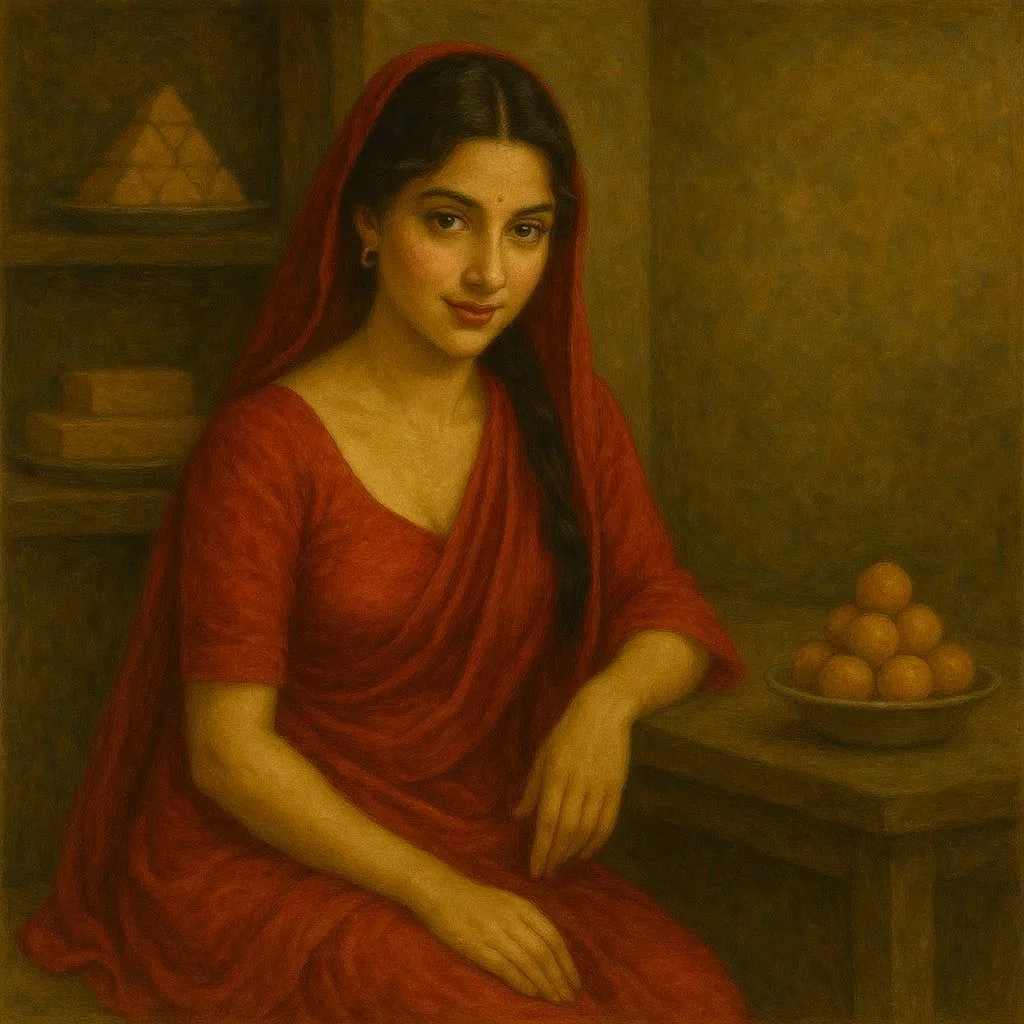
This is a story from a time long, long ago.
In the prosperous land of Pholna in Hindustan, there was a famous sweetmaker’s shop. The sweets from this shop were renowned far and wide. Customers came in droves, and the sweetmaker was never short on money. He had a grand house, a luxurious bed—but even on that soft bed, he couldn’t sleep peacefully at night.
Why? Because he had no children. The childless sweetmaker lived in sorrow. To forget his grief, he kept a talking parrot as a companion.
Years passed in this manner, until one day, fate changed. The sweetmaker’s wife became pregnant and gave birth to a daughter as beautiful as the moon. Her beauty surpassed even the finest sweets in the shop. Everyone who saw her felt an immense peace in their hearts—so they named her Delaram, meaning “heart’s peace.”
“Such beauty was granted by Allah above,
Like a fairy she appeared, full of love.
When her fortieth day arrived,
They named her Delaram, and joy revived.”
As Delaram grew older, she began helping her father in the shop. He sold sweets, and she offered cool water to the customers. The sweetmaker loved his daughter so deeply that he feared someone might one day trick him and steal her away. The fear aged him prematurely.
So one day, the sweetmaker performed a dark ritual. He took a lock of Delaram’s hair and created a magical talisman. He fed this talisman to his pet parrot. When the parrot died, he threw its body into a deep enchanted well.
After this, he began planning for Delaram’s marriage.
Delaram was so graceful and talented that suitors came from far-off lands—princes, merchant sons, noblemen—all wishing to marry her. But the sweetmaker set a condition: to marry his daughter, the suitor must fill the well (the one holding the enchanted parrot) with diamonds, rubies, and precious jewels. Not a single corner of the well could remain empty.
But the well was enchanted. No amount of wealth could fill it. So, one by one, all the suitors failed and left disappointed.
“None could fill the cursed well’s deep core,
All left defeated, trying no more.
Shiploads of riches they poured in vain,
The bottom never met the gemstone rain.”
Meanwhile, Delaram sat quietly, her heart heavy. She loved her father dearly but could not understand this stubborn demand of his.
In a neighboring kingdom, there lived a kind and just prince named Jamal. His sense of fairness and beauty was known across the lands. Delaram had heard of him too.
One night, Prince Jamal had a dream. In the dream, Delaram appeared and introduced herself:
“I am the sherbet of your thirst,
My name is Delaram, your heart’s first.
My home lies in the land of Pholna,
Daughter of a humble sweetmaker, halwaai.”
After that dream, Jamal was completely smitten. He couldn’t think of anything or anyone else. Ministers and nobles were alarmed—what had become of their prince?
When he told his vizier about the dream, the vizier was outraged.
“You are a prince, ruler of a mighty realm. And you’re losing yourself over a mere sweetmaker’s daughter? It’s beneath your dignity!”
But Prince Jamal was not like the others. He didn’t believe in social ranks or wealth.
“Love sees no caste, nor riches nor name,”
“Who seeks the heart, seeks no fame.”
But the vizier didn’t understand. He approached King Namdar, Jamal’s father. Together, they hatched a plan. They built a fake sweet shop at the edge of the city—complete with all kinds of sweets, just like the real one. In one corner, they placed a beautiful maiden adorned with pearl necklaces, gold bangles, and a lovely printed sari.
Then, the vizier told Jamal, “Delaram has arrived in our city. She’s opened a shop at the edge of town.”
Overjoyed, Jamal rushed to the shop. But the fake Delaram didn’t have the birthmark on her foot—the one the real Delaram had. So Jamal wasn’t fooled. He returned to his sorrow, grieving once more. The vizier’s plan had failed.
Ignoring everyone’s warnings, Prince Jamal mounted his horse and rode off in search of Delaram. The vizier, who loved him dearly, followed.
Together, they reached Hindustan and found the sweetmaker’s shop. After tasting the sweets, Delaram served them sherbet. One look at her, and Jamal fainted. Once he recovered, the vizier proposed marriage to her father.
But the sweetmaker remained firm. He repeated the same condition:
“There’s a well at home, a cursed one,
Fill it with treasure if you want my daughter won.”
But the enchanted well swallowed all treasure, revealing no bottom. Prince Jamal poured in his kingdom’s wealth—and lost everything. The king he was yesterday had become a pauper today.
Seeing this, the vizier pleaded with Jamal, “There’s no end to this greed. The sweetmaker is cunning. You won’t find happiness here. Let us return home.”
But Jamal’s heart would not agree. He gave up everything and became a woodcutter in the forest. Every day he chopped wood, sold it in the market, and used the coins to fill the enchanted well. It never filled. Yet, he kept going—burning in the sun, drenched in the rain. He sometimes visited the sweet shop just to glimpse Delaram and taste her sherbet.
Then he would return to the forest, whispering her name with every breath.
He lived only for her.
Will Prince Jamal ever be able to fulfill the sweetmaker’s impossible demand?
Will he win the heart of his dream, Delaram?
Or will Delaram be forever bound by her father’s spell?
One day, Jamal was carrying a bundle of firewood when a princess noticed him. The moment she saw him, she felt a deep sympathy. She called her vizier and said, “Bring that woodcutter to me.”
Once Jamal was brought before her, she bought all his wood and asked gently, “Why do you look so burdened? For whom do you labor day and night? Why do you weep with such sorrow?”
Jamal revealed his identity, saying:
“Listen, dear lady, to my tale of grief.
My name is Shah Jamal,
My home lies in a city far away.
I am the son of King Amin—
But misfortune cast me into exile.”
Hearing this, the princess said, “My younger brother’s name is also Jamal. You share his name—you’re like a brother to me too. Tell me the truth, what sorrow lies in your heart? Who brought ruin upon your fate?”
Then Jamal told his pretend sister, the princess, everything. He spoke of how Delaram came to him in a dream, how he had abandoned everything to seek her, how he’d run mad to a confectioner’s shop where he was tricked. He told how the confectioner had taken all his wealth in exchange for a promise, and how he was left penniless.
Delaram, it turned out, had been a childhood friend of the princess. The clever princess made up her mind to save Jamal from the confectioner’s wicked tricks and reunite him with Delaram. She decided to summon Delaram to the palace to get the truth out of her. But before doing that, she called the royal barber and had Jamal dressed in the finest clothes, made to look like a prince.
When Delaram came and saw Jamal, her reaction was striking:
“Delaram’s eyes fell upon Jamal—
Seeing him, she was overcome with confusion.
Like a bird trapped in a cage,
She fluttered helplessly, lost for words.
Her face grew pale with thought,
As though struck by an unseen arrow.
Her heart, caged in sorrow,
Longed to fly but could not.”
Day and night, love for the “prince” blossomed in her heart. She burned in the fire of love. The princess noticed this too and, after a few days, asked Delaram what troubled her heart. Delaram confessed her sorrows—how she could not marry because of her father’s strange condition.
Putting the pieces together, the princess then asked about Jamal. “Who is this handsome man? I’ve been to your home many times but never saw him—what brother of mine is this?”
Then she asked directly if Delaram liked her “brother.” If she did, then she must confess the truth about the strange well in their house—why it could never be filled, no matter how much wealth was poured into it.
Delaram couldn’t hide anymore. She told her childhood friend everything:
“The day I was born, my father took a lock of my hair
And made a talisman from it.
He fed it to his pet parrot.
The parrot died immediately.
Its body was thrown into the family well.
From then on, the well became magical—
No amount of gold or jewels could ever fill it.”
“Foxes cry ‘hukka-hua,’ dear friend,
Tell me—what can we do?
How can we fill that well?
How will my marriage ever happen?”
Delaram continued:
“There’s only one solution—
If someone takes my hair, dips it in milk,
And throws it into the well,
Only then will the curse break,
And the hidden treasures rise.”
Quietly, the wise princess took two locks of Delaram’s hair, hidden among the flowers in her headpiece. That night, she returned to her pretend brother Jamal and handed him the strands.
Jamal, who had waited so long for this chance, dipped the hair in milk from a sacred cow and rushed to the well. The moment he dropped the strands in, a miracle occurred.
All the jewels, diamonds, pearls, and gold hidden in the well for so long rose to the surface, shining so brightly they lit up the house—even in the dead of night.
Seeing this, the confectioner had no choice but to surrender.
“You’ve proven yourself,
You are worthy of my daughter.
Go now—live in peace and joy together.”
So, the confectioner married his daughter Delaram to Jamal. But he couldn’t bear to part with his beloved daughter. Unable to handle the sorrow of her departure, the confectioner died.
“The confectioner died,
His turban fell to the floor,
Leaving behind all his worldly goods.
All his riches and treasures
Now belonged to the afterlife.”
After his death, the princess packed all his wealth—enough to fill seven ships—and sent Jamal and Delaram off to Jamal’s homeland.
But fate had other plans. In the middle of the sea, a terrible storm rose. The ships sank, the crew perished, and all the wealth was lost to the waves.
Clinging to life, Jamal and Delaram saw a crocodile in the distance. They climbed onto its back and floated for three days and nights. The crocodile finally left them at the shore.
Once ashore, Delaram gave Jamal the pearl from her earring and asked him to buy food and clothes. But in the marketplace, Jamal fell into the trap of a wicked jeweler. The jeweler had long desired Delaram but never dared approach her while her father lived. Hearing Jamal’s story, he tricked him and abducted Delaram.
When Jamal returned with supplies, Delaram was gone.
In despair, Jamal tried to drown himself in the sea. But as fate would have it, the jeweler’s house was by the shore. Delaram secretly sent word to Jamal through a maid, asking him to come at night with two horses to rescue her.
But again, fate played cruelly. Before Jamal could arrive, Delaram was captured by the king of Isfahan. Struck by her beauty, he wanted to marry her. Despite her protests that she had a husband, he kept her imprisoned.
Meanwhile, Jamal wandered in search of her, hopeless and broken.
After much hardship, with help from a kind merchant, Delaram finally escaped—disguised as a man. She traveled for miles, for days and nights, until at last, she found Jamal again.
Once they had lived in palaces, surrounded by gold and servants. Now, they looked like beggars. But seeing each other again, they were filled with joy.
Without delay, they journeyed back to Jamal’s homeland and to his parents.
Seeing their long-lost son return, the joy of the king and queen knew no bounds:
“All sorrow was washed away—
The withered tree bore fruit again,
Like a full moon rising on a new moon night.
The queen dropped her bundle, speechless,
Showering gold coins in joy.
After five long years,
Their son and daughter-in-law returned—
Like light flooding into a darkened room.”